
Shaved-down Turkey teeth: when healthy teeth get filed down
A laboratory study weighed model front teeth: preparing one for a full crown removed about two-thirds of it above the gum. That is what shaved-down teeth are.
Reviewed by Yiğit Bal, dentistWritten in Turkey by a dentist. Klinikle is a clinic directory, not a clinic — no practice pays to appear here, and we do not provide treatment. Where a page compares Turkey with treatment at home, read it knowing where it was written.
Last updated:
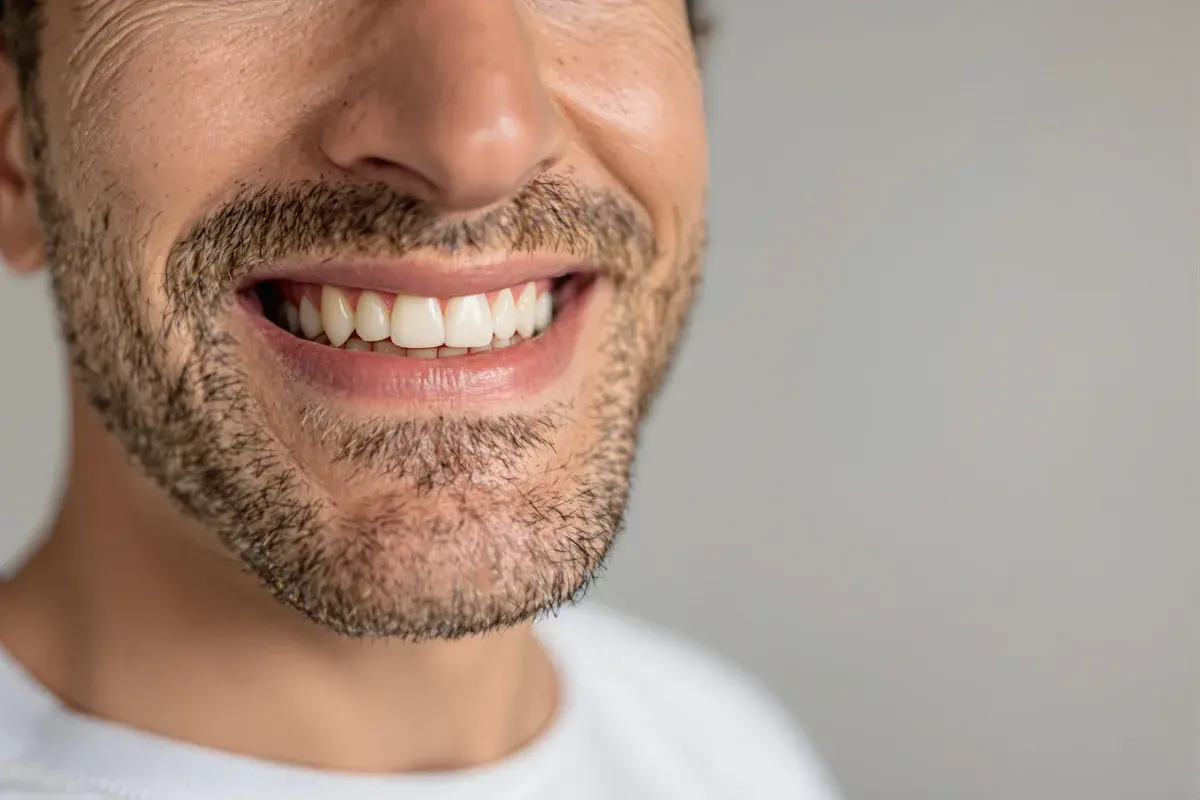
“Shark teeth”, “stumps”, “pegs”: the words people reach for when they see natural teeth shaved down, in the days between preparation and fitting. What gets called Turkey teeth shaving is the preparation for full crowns: each tooth is cut back on every side so a crown can cover all of it. A veneer covers the front only and, prepared conventionally, takes a thin layer from that face. On a broken or root-treated tooth a crown preparation is routine. The worry is the same cut on a sound tooth, made only for colour or shape.
Why shaved teeth look like shark teeth
The look is built into the preparation: a ceramic crown needs an even thickness all round, so a layer comes off the front, back, sides and biting edge. The side walls taper slightly, since a crown slides on from one direction and would jam on parallel walls. An upper front tooth is already a thin wedge, so with its edge shortened and corners rounded it becomes a narrow cone. Lower front teeth end up as spikes, back teeth as stumps. It is a normal stage of crown work, and a picture cannot show whether each tooth needed one. Video and forum close-ups share that limit, so read them with the habits in how to read reviews and Reddit threads.
A laboratory study that weighed resin model front teeth before and after preparation found that full-crown preparations removed about 63–72% of the tooth above the gum, and veneer and resin-bonded bridge preparations about 3–30%. Real teeth vary with shape and position. For the millimetre targets, see how much tooth should come off.
Four things push a plan past the cut it needs: a much lighter shade, which needs a thicker, more opaque layer; layered zirconia, which needs more room than a single-material crown; a whole arch prepared in one sitting, where teeth are cut to line up with each other instead of each to its own need; and crooked teeth straightened with the bur. Whether a tooth needs a crown at all is the question behind veneers or crowns.
The cost to the tooth, in order
The nerve
Most shaved teeth keep a living nerve, but in some it dies. One prospective study followed 120 teeth from crown preparation to cementation. In 9% the nerve died without symptoms: 5% of the teeth that had been sound, and 13% of those already decayed, filled or crowned. One short study cannot put a number on the risk for your mouth. On a sound tooth the same risk is taken for nothing more than a change of colour, and what can follow is a root canal on a healthy tooth.
The margin
The join between crown and tooth sits at or just under the gum and remains the weak point for as long as the crown is there. Plaque can gather at it and the gum can draw back over the years, so gum recession around crowns can appear long after the fit. Decay under a crown edge is often found late.
The next thirty years
Each replacement means cutting off the old crown and taking a little more tooth. Crown, then for some teeth a root canal, a post and eventually extraction: starting down that path with a healthy tooth at thirty is a different decision from starting it with a damaged one at fifty. For how long the crowns themselves survive, see how long Turkey teeth last.
The five minutes when it becomes irreversible
Shaving cannot be reversed. Enamel and dentine do not grow back, so a tooth prepared for a crown needs one from that day on.
Until the handpiece starts, everything can still change. After that, the only open question is which crown, so settle the plan before you fly, when saying no costs nothing. Temporary crowns are then your one chance to live with the shape, length and shade before the final set is made, midway through the Turkey teeth process, step by step.
Veneers without shaving have limits
On the right teeth, veneers without shaving work well. A no-prep veneer is bonded onto the tooth as it is, so the tooth ends up slightly fuller. That suits small, set-back or spaced teeth, worn edges and a modest change of shade. Teeth that stand forward or are rotated suit it poorly, given that added material pushes them further out, and a thin layer cannot hide a dark tooth. The trial evidence is modest: a 2025 review of four randomised trials, 612 veneers followed for two to nine years, found no-prep veneers survived well, failing mainly through chipped edges and debonding.
When a plan promises veneers in Turkey with no shaving, ask two things. Will any tooth be touched with a bur, even to smooth an edge? And if the mock-up looks bulky, what then? Insist on seeing the veneer mock-up before deciding, because a bulky one is the point to compare no-prep or conventional veneers.
Six questions before anyone picks up a drill
- Which of these teeth are healthy and unrestored right now? Yes or no, per tooth; nothing else here matters as much.
- Is this a crown or a facing? The word in writing, tooth by tooth, with how much of each comes off.
- What would happen if we did nothing to this tooth? Expect a separate answer for each tooth.
- What were the less invasive options, and why were they ruled out? Whitening, bonding, replacing one visible filling, straightening crowded teeth.
- Can I see a wax-up or a digital preview first? That is an ordinary request.
- Will I have temporaries, and for how long? Under a couple of days hardly counts as a trial.
On a plan, “crown”, “full coverage”, “zirconium veneer” and “e.max crown” usually mean every surface cut, while “veneer”, “laminate” and “minimal prep” mean a facing. That muddle is where what people mean by Turkey teeth comes from. Look first at teeth whitening in Turkey, bonding or veneers and veneers or orthodontics. A tooth count that surprises you deserves the checks in plans with too many crowns.
If it has already happened
Still in Turkey, temporaries in. Shape, length and shade can still change. If anything looks wrong, say so now, however awkward it feels.
Final crowns fitted, unhappy with the look. A remake means cutting off the crowns and preparing the teeth again, at a little more cost to each tooth, so do not start one unless the clinic’s plan, X-rays and shade record are in your hands.
Sensitivity or pain weeks later. Often it settles. Sometimes the nerve has not recovered, so have it examined and X-rayed where you live even if the pain fades.
Fine now, worried about later. Crowned teeth need closer monitoring as a rule: check-ups, careful cleaning at the margins and the paperwork listed in what your records should include.
Warning signs fall into four levels.
- Watch: a brief twinge to cold, or tender gums at the crown edges.
- See a dentist this week: lingering pain to hot or cold, a tooth turning grey, a crown that moves.
- See a dentist within a day or two: toothache that wakes you, pain on biting, a spot or swelling on the gum above a crown, or a swelling of the face that is not spreading. Outside surgery hours, England’s NHS 111, Scotland’s NHS 24 and NHS 111 Wales all answer on 111; in Northern Ireland, start with your own dentist, then the Emergency Dental Clinics over weekends and bank holidays.
- Go now: a swelling climbing towards the eye, spreading into the neck or growing fast; swelling under the tongue; a swelling that brings on a high temperature or makes it hard to swallow; bleeding that has not eased after 15–20 minutes of pressing firmly. That means A&E in the UK and an emergency department anywhere else, including a hospital acil servis in Turkey. If breathing gets hard or the person becomes drowsy or confused, call an ambulance instead of getting yourself there: 999 (UK), 112 or 999 (Ireland), 911 (US and Canada), 000 (Australia), 112 (Turkey).
In England an NHS dentist can see to pain or infection, while a remake for appearance is usually private; for the other three nations, see whether the NHS will fix Turkey teeth.
Remakes in the US, Canada or Australia
Start with a general dentist and X-rays. If several crowns are failing or a whole arch needs redoing, ask about a prosthodontist, a specialty recognised in the US through the American Dental Association. Dental plans in North America, and Australian extras cover, vary on work done abroad, so get your insurer’s answer before any remake. Anyone insured in the US should read up on dental work in Turkey from the US first.
One email to send first
This week, ask the clinic in writing for the X-rays taken before and after preparation, each crown’s material and shade and the treatment plan with tooth numbers. With those, a dentist where you live can see what was there before and carry on with aftercare when you get home.
Sources
- Edelhoff D, Sorensen JA. Tooth structure removal associated with various preparation designs for anterior teeth. The Journal of Prosthetic Dentistry. 2002.
- Kontakiotis EG, et al. A prospective study of the incidence of asymptomatic pulp necrosis following crown preparation. International Endodontic Journal. 2015.
- Hameed FFS, et al. Clinical outcomes of no-prep veneers and conventional veneers: a systematic review. The Journal of Contemporary Dental Practice. 2025.
- NHS England. Avoidance of doubt: clinical policy for self-funded dental treatment requiring NHS intervention. 2024.
- National Commission on Recognition of Dental Specialties and Certifying Boards (American Dental Association). Recognized Dental Specialties. 2026.
This page is general information, not medical advice. Outcomes vary between individuals and suitability can only be established after an in-person examination and imaging by a qualified dentist.
Related reading
Get an honest assessment first
Tell us what you're dealing with and we'll come back on WhatsApp with a straight answer — including whether travelling is worth it for your case at all. No photos needed to start.