
What are Turkey teeth? What people mean by the phrase
British slang for healthy teeth filed down and capped with full crowns, sometimes veneers. It names a technique, and the country is almost incidental.
Reviewed by Yiğit Bal, dentistWritten in Turkey by a dentist. Klinikle is a clinic directory, not a clinic — no practice pays to appear here, and we do not provide treatment. Where a page compares Turkey with treatment at home, read it knowing where it was written.
Last updated:
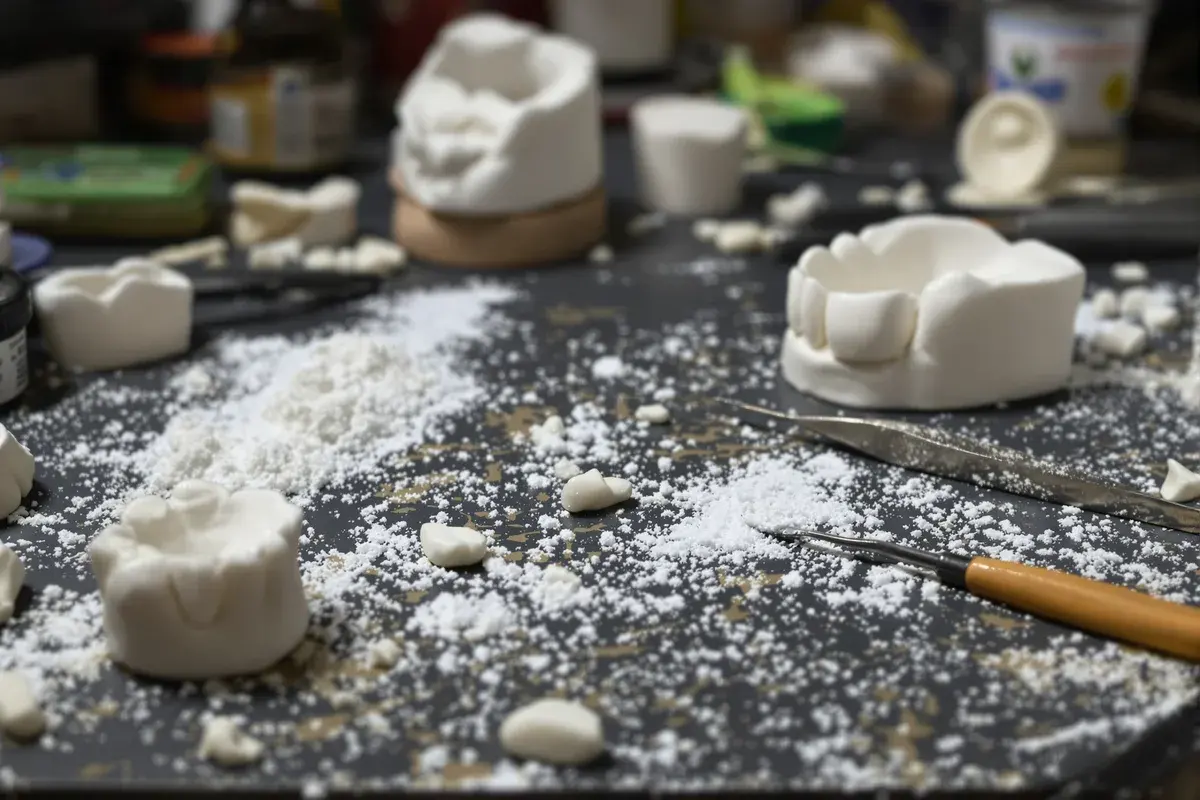
In British slang, “Turkey teeth” is a put-down, not a clinical term. It usually describes natural teeth, many of them healthy, filed down on every side and covered with a full set of crowns, most often zirconia. Occasionally the covering is a set of veneers instead. That is also what a high-street dentist will tell you people mean by Turkey teeth: a whole visible arch crowned in a single trip of about a week.
An insult with a short history
As a phrase it is shorthand for a look: very white, very even teeth, often a little large for the face, in one shade from corner to corner. It is used as a joke and just as often as a jibe.
It took hold through reality television and social media in the early 2020s, and readers in the US, Canada and Australia now meet it with the same meaning. It hardened as BBC News reports and a BBC documentary followed patients who came home with pain, infections or teeth that could not be saved. The British Dental Association took the subject up publicly, warning about hard selling, informed consent and aftercare once patients are home. When the BDA polled 1,000 UK dentists online in February 2022, 944 said they had seen patients who had been treated abroad, and 86% of those had gone on to treat problems afterwards, crowns more often than anything else. A poll of dentists who see the problems cannot tell you how often treatment abroad goes wrong; that wider question belongs to whether Turkey teeth are safe.
The treatment people are describing, and what it is made of
Clinically, the procedure is full-coverage crown preparation, and the Turkey teeth process, step by step is short: teeth trimmed on every surface, temporaries while the laboratory works, then the final set across the visible arch, all within about a week. The stage in between, when the prepared teeth stand narrow and pointed, is what social media calls “shark teeth” or “pegs”, and it is the subject of shaved-down teeth.
Crowning is ordinary dentistry for a tooth that is broken down, root-treated, cracked or carrying a large old filling. The objection is to doing it to sound teeth purely to change their colour and shape, because reduction is permanent: a crowned tooth stays crowned, and every later problem is dealt with on top of that first decision.
Most sets are zirconia. Monolithic zirconia is milled from one block and hard to chip, and older versions looked flat and opaque; layered zirconia has porcelain fired over a zirconia core, and the porcelain looks more lifelike but is also the part that chips. Lithium disilicate, sold as e.max, is a more translucent glass-ceramic often used on front teeth. Metal-ceramic, porcelain over a metal substructure, is the older option. Composite resin is used in less invasive work: bonding and composite veneers. The crown ceramics go head to head in zirconia or e.max. The flat, bright white the nickname mocks comes mostly from the shade, a bleach shade outside the natural range: see tooth colour and shade choice.
Brochures often call the crown plan a “Hollywood smile”, a name that leaves open whether crowns or veneers are involved. The treatments behind it are separated out in veneers in Turkey.
Crown or veneer: what comes off the tooth
A veneer covers the front of a tooth; a crown covers all of it. The sets people call Turkey teeth are usually crowns, and the two differ on every count:
| Conventional veneer | Full crown | |
|---|---|---|
| How much comes off | About a quarter to a half of what a full crown takes, by weight (laboratory study on model front teeth) | About 63–72% of the visible tooth, by weight |
| Which surfaces | The front, sometimes the biting edge | Every surface |
| Can it be undone | No, once enamel is cut; no-prep veneers are the exception | No; the tooth will always need a crown |
| The nerve | Preparation usually stays within enamel | Deeper cut; in a proportion of teeth the nerve dies |
| What renewal involves | A new veneer on a largely intact tooth | Old crown cut off, a little more tooth lost |
| When it is the right answer | Sound teeth needing a new colour or shape | Teeth broken down, cracked, root-treated or heavily filled |
What a veneer is
Usually porcelain or composite. A conventional porcelain veneer takes about 0.3–0.7 mm from the front of the tooth, a little more if it wraps the edge, and no-prep veneers take none.
What a crown is
A cover for the whole tooth. Fitting one means reducing it by roughly 1–1.5 mm on each side and 1.5–2 mm from the biting surface. What those millimetres leave behind is the subject of how much tooth should come off.
Why the words get swapped
“Veneer” sounds gentler, so it is used for both. On a treatment plan, “zirconium veneers” almost always means full zirconia crowns, and some people only realise when they see their prepared teeth in the mirror. For the clinical case behind each, read veneers or crowns. A course of crowns, visit by visit, is followed on crowns in Turkey.
Questions that reveal which one you are being offered
| What you are told | What it may mean | What to ask instead |
|---|---|---|
| “Zirconium veneers” | Full-coverage zirconia crowns | “Is this a full crown or a facing, and how much of each tooth comes off?” |
| “No preparation, we just polish” | Sometimes true, sometimes a loose description of a full preparation | “Can you show me the prep design or a wax-up before you touch anything?” |
| “Twenty veneers in five days” | Full-arch crown work on a compressed schedule | “Which teeth have a clinical reason to be crowned, and which are for appearance?” |
| “Whitening won’t work on your teeth” | May be accurate, may be a route to crowns | “What would whitening and bonding achieve, and why are they ruled out?” |
Get the answers in writing, tooth by tooth, at the level of detail in what a treatment plan should contain.
If you already have Turkey teeth
NHS England’s 2024 policy on self-funded treatment covers work done abroad. An NHS dentist in England can assess you and, if you are taken on as an NHS patient, deal with pain and infection. Anything beyond that is judged against normal NHS provision: veneers are generally private unless there is a clinical need, and so, as a rule, is replacing crowns just to change how they look. Wales, Scotland and Northern Ireland run their own NHS dental systems, and whether the NHS will fix Turkey teeth takes the four in turn.
Ask the clinic for your records crown by crown, to the standard of what your records should include: a dentist at home repairs with more confidence knowing each material, shade and root-treated tooth.
A crowned tooth that aches at night, or a gum that swells over one, needs a dentist soon. Out of hours, dial 111 for NHS 111 in England, NHS 24 in Scotland or NHS 111 Wales. Northern Ireland differs: your own dentist first, then the Emergency Dental Clinics on weekends and bank holidays. Some signs cannot wait: swelling heading for the eye or into the neck, or visibly bigger by the hour; a floor of the mouth that lifts the tongue; fever or trouble swallowing along with a swelling; bleeding that firm pressure has not controlled within 15–20 minutes. Those belong in A&E, or an emergency department outside the UK. Struggling to breathe, or turning drowsy or confused, means ringing for an ambulance and staying put: 999 on a UK phone, 112 or 999 on an Irish one, 911 in North America, 000 for Australia.
When asking a North American dental plan, or an Australian extras cover insurer, what it pays towards repairs, call the work full crowns. The nickname means nothing on a claim form. American readers will find Medicare and tax questions under dental work in Turkey from the US, and Canadians theirs in coming from Canada. Survival figures for both crowns and veneers are in how long Turkey teeth last.
Crowns, implants, bonding: the questions behind the nickname
What are Turkey teeth made of?
Zirconia in most sets, milled from one block or layered with porcelain; front teeth are sometimes lithium disilicate (e.max), and older work may be metal-ceramic. Ask for each crown’s material by name in your records, because a dentist at home repairs like with like.
Are Turkey teeth crowns or veneers?
Crowns, in the sense the nickname carries: the teeth were reduced on every side and covered completely. Genuine veneers cover the front and remove a fraction of the enamel, though across a room the two look alike. One examination at home usually settles which you have.
Are Turkey teeth implants?
Not in the usual sense. Turkey teeth are crowns or veneers on teeth that are still there, whereas an implant replaces a lost tooth with a post in the jawbone and a crown or bridge on top, the treatment in dental implants in Turkey. Some people use the phrase loosely for any dental work done in Turkey.
Is composite bonding the same as Turkey teeth?
No. Composite bonding adds tooth-coloured resin to the surface, usually with little or no drilling, and can be repaired or removed without losing much tooth. In the strict sense, Turkey teeth involve cutting teeth down for ceramic crowns; for the resin route, see composite bonding in Turkey.
Are Turkey teeth going out of fashion?
Nobody publishes figures that would settle it. The bright, uniform set is now the look people picture when they hear the phrase, and it is easy to avoid, provided shade and shape are agreed before anything is made. Fashion is a poor reason to remove enamel, because the preparation outlasts the trend.
Why the label attached itself to a country
Volume. Turkey built a large dental sector for overseas patients just as NHS appointments were getting harder to find, so the visible examples of this technique, good and bad, were disproportionately Turkish. Cosmetic dentistry in Britain had produced the same results for decades without a nickname. For what a plan there costs, and why quotes differ, see how much Turkey teeth cost.
The trade also brought titles Turkish law does not recognise: cosmetic or aesthetic dentistry is not among the official dental specialties, so a “cosmetic dentist” title is a marketing label. The documents that prove a genuine specialty are listed in how to check a dentist’s qualification.
Whoever plans the work, in a clinic in Antalya or on a video call from Leeds, should be able to answer this beside every tooth number: “How much of this tooth are you removing, and what is the clinical reason?”
Sources
- British Dental Association. UK dentists picking up the pieces from dental tourism boom. 2022.
- Edelhoff D, Sorensen JA. Tooth structure removal associated with various preparation designs for anterior teeth. The Journal of Prosthetic Dentistry. 2002.
- Kontakiotis EG, et al. A prospective study of the incidence of asymptomatic pulp necrosis following crown preparation. International Endodontic Journal. 2015.
- NHS England. Avoidance of doubt: clinical policy for self-funded dental treatment requiring NHS intervention. 2024.
- NHS. Dental treatments. 2026.
- Republic of Türkiye. Tababet ve Şuabatı San’atlarının Tarzı İcrasına Dair Kanun (Law No. 1219), Schedule 2 on dental specialties, as amended. 2018.
This page is general information, not medical advice. Outcomes vary between individuals and suitability can only be established after an in-person examination and imaging by a qualified dentist.
Related reading
Get an honest assessment first
Tell us what you're dealing with and we'll come back on WhatsApp with a straight answer — including whether travelling is worth it for your case at all. No photos needed to start.