
Dental crowns in Turkey: zirconia, e.max and what you get
A crown covers a tooth ground down on every side. In Turkey that usually means zirconia or e.max, and the quote should name the units, lab and temporaries.
Reviewed by Yiğit Bal, dentistWritten in Turkey by a dentist. Klinikle is a clinic directory, not a clinic — no practice pays to appear here, and we do not provide treatment. Where a page compares Turkey with treatment at home, read it knowing where it was written.
Last updated:
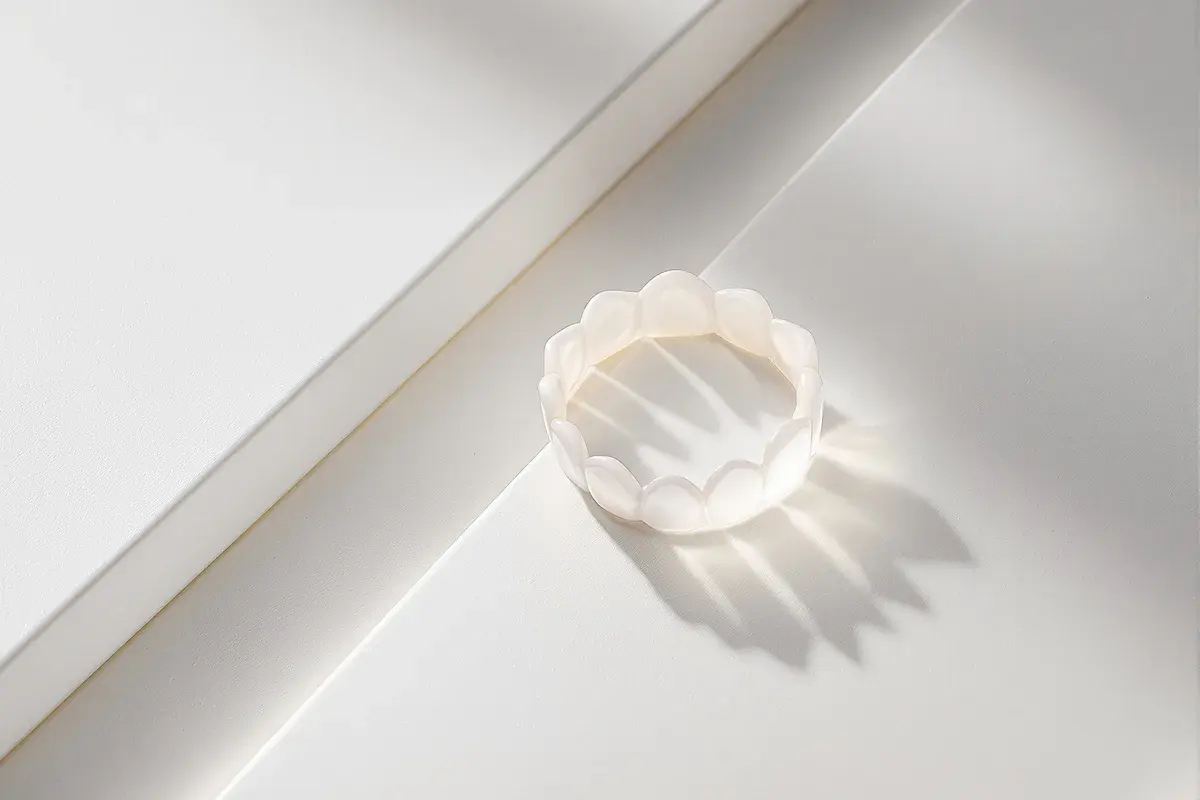
Dental crowns in Turkey are laboratory-made caps fixed over teeth that have first been ground down on every side. A bridge is crowns joined up: two on the teeth either side of a gap, carrying a false tooth between them. Crowns made in Turkey are usually zirconia or lithium disilicate (best known as e.max). “Turkey teeth crowns”, or “Turkish crowns”, usually means a full set across the smile, often over sound teeth. Veneers can produce the same look, but the sets behind what people mean by Turkey teeth are more often crowns.
The tooth each option takes
Most ways of reshaping a tooth take something from it, permanently. The millimetres below are usual preparation targets; the percentages, by weight, come from Edelhoff and Sorensen’s 2002 laboratory study of model front teeth, so treat them as a rough guide.
| Option | What comes off | Which surfaces | Afterwards |
|---|---|---|---|
| Composite bonding | Usually nothing; the enamel is etched | Front and edges | Can largely be removed again |
| Conventional veneer | About 0.3–0.7 mm from the front; roughly 3–30% by weight, depending on the design | The front, sometimes the biting edge | A cover on the front |
| Full crown | About 1–1.5 mm from each side and 1.5–2 mm from the biting surface; roughly 63–72% by weight | Every surface | A crown, for good |
| Three-unit bridge | A full crown preparation on each tooth beside the gap | Every surface of two teeth | Crowns on both, for good |
A heavily filled, cracked or root-treated tooth has often lost so much already that a crown protects what is left. A sound tooth that only wants a new colour loses more to the drill than it ever lost to the problem.
Crown materials, and what “zirconium” means on a quote
Zirconium is a metal; the crowns are zirconia, its ceramic oxide, so a quote offering “zirconium crowns” is already loose with its terms.
Material and drilling are linked. A ceramic needs a minimum thickness to be strong and to hide what lies beneath it, and that thickness comes from the tooth. Over a dark or heavily filled tooth the laboratory adds an opaque layer, which takes room too. Layered porcelain takes more again, and metal-ceramic needs the most: a metal shell, an opaque coat, then porcelain. Monolithic zirconia can be milled thinner than any of these and still resist breaking, which is why it suits back teeth. Glass ceramic can be thin where it bonds to healthy enamel, whereas a tooth that has lost that enamel needs more bulk. A plan that names the material without the preparation has skipped a step.
Shade is a separate choice, made in daylight before preparation: see tooth colour and shade choice.
A 2015 systematic review by Sailer and colleagues found 94.7% of metal-ceramic, 96.6% of glass-ceramic and 92.1% of zirconia single crowns still in place after five years. The zirconia crowns in those studies carried layered porcelain and were lost more often to that porcelain fracturing and to coming loose, so the figures say little about monolithic zirconia. Longer-term figures are in how long Turkey teeth last, and zirconia or e.max sets the two modern ceramics side by side.
Monolithic zirconia
One solid milled block with no porcelain to chip; the usual choice for molars and for people who grind their teeth. Older versions looked chalky at the front, and newer translucent grades trade some strength for looks.
Layered zirconia
Fired porcelain over a zirconia core looks more lifelike, and the porcelain is the part that chips, at an edge or a corner.
Glass ceramics (e.max)
On front teeth lithium disilicate tends to look among the most lifelike of the four, since light passes into it much as into enamel, and it bonds to the tooth. It is less suited to heavy grinding on molars.
Metal-ceramic
Porcelain over a metal substructure, the oldest option and still used for long bridges. Receding gum can expose a dark line at its edge.
Full-mouth crowns, as a plan and as a warning sign
“Full-mouth crowns” in Turkey usually means every tooth that shows in a smile, crowned in one stay. Sometimes that is the right plan: teeth worn flat by grinding or acid until the face has lost height, an arch full of large fillings and old crowns, a bite that collapsed after back teeth were lost. Work on that scale is planned with models and a trial bite in temporaries.
The same count becomes a warning sign when the teeth are sound and the reason given is appearance, the “smile makeover”. Crowning healthy teeth for colour takes most of each one for something whitening, bonding or veneers might have done, and leaves shaved-down teeth.
Preparation also tests the nerve. Cutting close to it can kill it without symptoms, sometimes before the crown is even fitted and more often in teeth already heavily filled. Every extra tooth in the plan adds to the chance of root canal treatment later. To test a plan that has grown, use the questions in plans with too many crowns, and for mostly sound teeth compare veneers or crowns first.
The number of units is a clinical decision
Plans for travelling patients often arrive as a round number for a whole smile, and the number then shapes the plan. For the same mouth, ten crowns for a tidier smile and four on the broken-down teeth are two different plans, and a back tooth with sound outer walls may need only an onlay.
Two items need asking about directly. Root canal treatment on a tooth that looked sound can become necessary when its nerve is dying or the preparation exposes the pulp. Done routinely across an arch to speed the work, it weakens each tooth from the inside, and root-treated teeth fracture more readily. Crowns can disguise mild crowding and leave the bite as it was; teeth well out of line have to be cut deeper to look straight, so orthodontics, which takes months, usually comes first.
Then ask plainly: “Which of these teeth would you crown if appearance didn’t matter?”
Six lines in a crown quote
Two crown quotes can be compared only when both carry these six lines; totals are a separate subject, how much Turkey teeth cost.
- Each unit by tooth number, so a block of crowns becomes a list you can check.
- The material for each tooth, and for zirconia, monolithic or layered.
- Temporaries: included or not, and for how long.
- The laboratory, and whether it sits inside the clinic or elsewhere.
- Root canal treatment, posts or core build-ups as separate lines.
- Written remake terms if a unit chips, loosens or fails.
Good work in the chair
Crowns usually fit one stay of five to seven nights, whatever the number of units: examination and X-rays, preparation and temporaries, a few days for the laboratory, a try-in, then fitting. No tooth should be prepared unless gum disease and active decay have been treated first. Preparation is done under local anaesthetic; most soreness comes afterwards, as cold sensitivity and tender gums that usually ease within two weeks of fitting.
Temporaries should fit snugly, since loose or bulky ones inflame the gum, and swollen gum changes the edge the final crown has to meet. Crowns should be tried in before cementing, with shade checked in daylight and contacts adjusted. The bite needs the longest look: a slightly high crown can catch when you tap or only when you slide your teeth sideways, so both should be checked. The ache it causes can take days to build.
Leave a couple of days between final cementation and the flight, so the dentist who fitted the crowns can adjust them. For the whole sequence, see the Turkey teeth process, step by step.
A crown-by-crown record
Whoever repairs a crown later needs to know what it is and what lies under it. Ask for a tooth-by-tooth list of the work, including root canals and posts; copies of the X-rays and scans; the material, shade and laboratory of each unit; and an itemised invoice.
Turkey’s Hasta Hakları Yönetmeliği (Regulation on Patient Rights) entitles you to inspect your file and take a copy of it. Before leaving, check that nothing on it reads only “ceramic crowns”. What your records should include gives the fuller list.
If something fails after you get home
Crowns come off, margins leak and a nerve that survived preparation can die a year or two later, at home or abroad, and after a trip the dentist who fitted them is a flight away. In rising order of urgency:
- A grey or dark line at the gum edge. Book a check with X-rays within a few weeks if it is new or widening, within days if it is sore. Receding gum showing a margin is the commonest cause, decay at the edge another.
- A chip you can feel. Small chips in layered porcelain can be polished; a crack through the crown usually means a remake.
- A bad taste from one crown. An X-ray can find leakage or decay at the margin before it hurts, so book an examination within days.
- A crown that has come off or is loose. Keep it and do not glue it back; see a dentist within days. One that came off in one piece may go back on, while one that moves may sit on a broken tooth or a loose post.
- Pain on biting or lingering sensitivity. A high spot, a crack or a nerve in trouble; book within days, or the same day if it throbs.
- A gum swelling or a gum boil. Get urgent dental advice the same day; out of hours that means NHS 111 in England, NHS 24 on 111 in Scotland and NHS 111 Wales.
Swelling that spreads towards the eye or neck or grows fast, swelling under the tongue, a fever or trouble swallowing with a swelling, or bleeding that 15–20 minutes of firm pressure has not stopped needs a hospital emergency department (A&E in the UK, the acil servis in Turkey). Trouble breathing, drowsiness or confusion means an ambulance instead of driving yourself: 999 in the UK, 112 or 999 in Ireland, 911 in the US and Canada, 000 in Australia, 111 in New Zealand and 112 in Turkey.
In England, crowns are ordinary NHS treatment where there is a clinical need. An NHS dentist who takes you on can deal with pain or infection around a crown made abroad; a remake for appearance is usually private. Whether the NHS will fix Turkey teeth takes the four nations one by one.
Elsewhere, take your records to a general dentist first. Whether a dental plan or insurer pays towards a replacement crown depends on its wording about work abroad, the question behind dental work in Turkey from the US, coming from Canada and coming from Australia.
Any remake terms run through the clinic that fitted the crown, and the order of calls after that, country by country, is in what happens if it goes wrong.
Sources
- Edelhoff D, Sorensen JA. Tooth structure removal associated with various preparation designs for anterior teeth. The Journal of Prosthetic Dentistry. 2002.
- Sailer I, et al. All-ceramic or metal-ceramic tooth-supported fixed dental prostheses (FDPs)? A systematic review of the survival and complication rates. Part I: Single crowns (SCs). Dental Materials. 2015.
- Kontakiotis EG, et al. A prospective study of the incidence of asymptomatic pulp necrosis following crown preparation. International Endodontic Journal. 2015.
- NHS. Dental treatments. 2026.
- NHS England. Avoidance of doubt: clinical policy for self-funded dental treatment requiring NHS intervention. 2024.
- T.C. Sağlık Bakanlığı (Ministry of Health, Turkey). Hasta Hakları Yönetmeliği (Regulation on Patient Rights), as amended. 1998.
This page is general information, not medical advice. Outcomes vary between individuals and suitability can only be established after an in-person examination and imaging by a qualified dentist.
Related reading
Get an honest assessment first
Tell us what you're dealing with and we'll come back on WhatsApp with a straight answer — including whether travelling is worth it for your case at all. No photos needed to start.