
Veneers or crowns for front teeth: how much tooth each takes
A sound front tooth usually suits a veneer or bonding, which keep more enamel; a broken or heavily filled one needs a crown. Most Turkey teeth are crowns.
Reviewed by Yiğit Bal, dentistWritten in Turkey by a dentist. Klinikle is a clinic directory, not a clinic — no practice pays to appear here, and we do not provide treatment. Where a page compares Turkey with treatment at home, read it knowing where it was written.
Last updated:
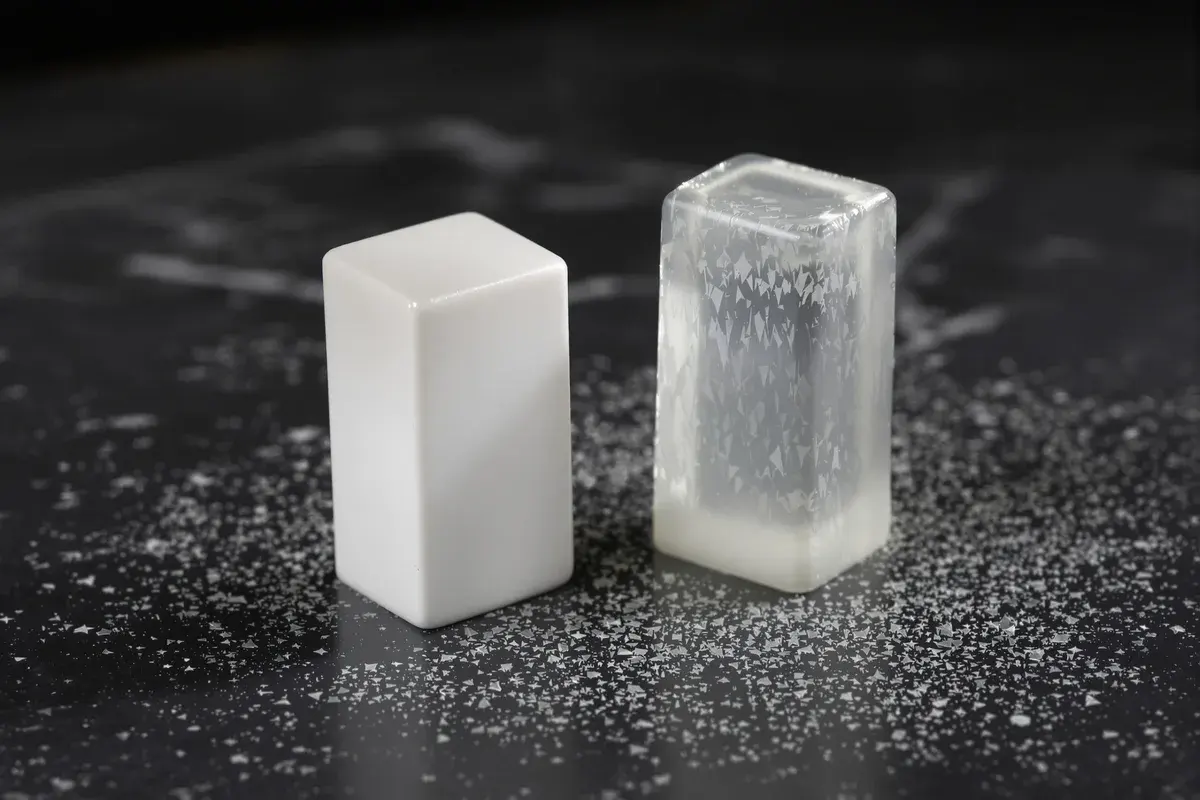
A veneer is a thin shell of ceramic or composite bonded to the front of a tooth. A crown is a cap that encloses the whole tooth above the gum. For a front tooth that still has most of its enamel, a veneer, or something less invasive such as bonding, is usually the better choice, and a crown earns its place on a tooth that is broken, heavily filled or root-treated. Most sets that fit what people mean by Turkey teeth are crowns, whatever the quote called them.
What decides it is the state of each tooth now: how much enamel is left, how much is old filling and whether the nerve has been treated. A dentist at home can answer all three from your records and X-rays.
Two restorations, two amounts of drilling
| Veneer | Crown | |
|---|---|---|
| Surfaces prepared | The front, often over the edge | Front, back, both sides, edge |
| Depth of reduction | 0.3–0.7 mm, a little more at the edge | Roughly 1–1.5 mm at the sides, 1.5–2 mm at the edge |
| Tooth above the gum removed (laboratory study, model front teeth, by weight) | About 3–30% (veneer and resin-bonded bridge designs together) | About 63–72% |
| Going back | Impossible, though a crown can follow | Impossible; the tooth stays crowned |
| The nerve | Rarely troubled while the cut stays in enamel | Died without symptoms before the crown was fitted in 9% of 120 teeth in one study (5% in previously sound teeth) |
| Survival in systematic reviews | 89% still in place at a median of nine years | About 92–97% at five years for the usual materials |
The survival figures count anything still in the mouth, chipped or repaired, and the two reviews ran for different periods, so they do not rank veneers against crowns.
A crown takes tooth from every side for engineering reasons. Ceramic is strong only above a minimum thickness, so the tooth loses that thickness wherever the crown sits. The walls must taper towards the edge, or the cap will not seat. Its margin needs a clean finishing line cut into the tooth at the gum, all the way round. Front teeth are narrow from front to back, so a millimetre from each wall leaves a slim core. A veneer needs room only on the visible face and holds by bonding to enamel, which near the gum is thinner than a millimetre. Once a cut goes through it, the bond is to dentine, which holds less well.
How much tooth should come off puts millimetres on those limits. Ceramic veneers and crowns are usually made in a laboratory and fitted at a second visit, and a crown may first need a root filling or a build-up, which shapes how many nights each treatment takes.
Front teeth specifically
Veneers are rarely used on back teeth, so this is a front-tooth choice. Where the enamel is intact and the change is to colour, outline or a small gap, a veneer is usually enough. Three things push a plan towards crowns.
A break is the first. A larger chip can take a veneer that wraps the edge, provided sound enamel surrounds it. A tooth broken near the gum usually needs a crown, sometimes on a post, and one split to the root or broken well below the gum often cannot be kept; only an examination with an X-ray tells you which. Colour underneath is the second. A tooth darkened after root canal treatment can often be whitened from inside; otherwise hiding it takes thicker, more opaque ceramic, cut from the tooth. Position is the third. A slight rotation can be disguised with extra cutting, but marked crowding is better straightened first, and an edge-to-edge bite or grinding loads the thin edge a veneer wraps.
Either can look natural at the front. When a crown does give itself away, it is usually through a shade that is too bright or a margin showing where the gum has receded.
Why the word “veneer” travels badly
Searches for “Turkey teeth vs veneers” compare things of different kinds: a veneer is one restoration, and “Turkey teeth” is the nickname for a whole visible arch done abroad, usually as crowns.
“Veneer” is the word patients type into a search box, so marketing uses it for both restorations, which come from the same laboratories and ceramics. In practice a plan sold as twenty veneers is sometimes twenty crowns, since a thin facing cannot straighten crooked teeth or rebuild badly worn ones.
Translation adds a layer. The everyday Turkish word for a crown is kaplama, literally “a covering”, so zirkonyum kaplama, a zirconia crown, can reach an English-speaking patient as “zirconium veneers”. A true veneer is usually called lamina or yaprak porselen (“leaf porcelain”).
A crown is still the correct treatment for a broken-down tooth. The trouble starts when the word at the consultation and the work in the chair do not match, the mismatch behind shaved-down teeth. Once you know which each tooth needs, veneers in Turkey and crowns in Turkey show what to check.
Pinning the plan down tooth by tooth
Put these three in writing before you book. If a reply does not name a tooth, ask again.
The word against each tooth
Ask for “veneer” or “crown” beside every tooth on the plan; a clinic that finds this pedantic has told you something useful. Turkish clinics usually number teeth in the two-digit FDI system, where the upper front pair are 11 and 21. A UK dentist may write UR1 and UL1 instead. Either works if every tooth is named.
How much comes off, and the nerve
Ask how far each tooth will be reduced and whether any is likely to need root canal treatment. “We are very conservative” says nothing about tooth 12.
The material of each one
Ask for the material against each tooth too. Whoever repairs one later needs to know what it is made of, and for crowns the usual question is zirconia or e.max.
Alternatives to a veneer or a crown
Colour alone
Whitening comes before anything new is matched, because existing crowns, veneers and fillings will not lighten with it.
Alignment
Moving crooked teeth with braces and aligners in Turkey or an orthodontist back home takes months and leaves the enamel largely in place, apart from a sliver sometimes polished off between teeth.
A small chip
Bonding is built up on the tooth, usually without drilling, and can be repaired in one visit close to home. It stains sooner than porcelain, a fair price for keeping the enamel. If only one tooth bothers you, start from bonding or veneers.
A gap where a tooth was
A veneer or a crown needs a tooth underneath, and a missing one is replaced with an implant, a bridge or a denture. A conventional bridge crowns the teeth either side, so if they are sound, compare an implant or a bridge for a missing tooth before anyone prepares them.
Veneers and crowns over the years
Ceramic meets tooth at a margin near the gum, and that join is where trouble starts: plaque collects there, and if the gum recedes, which is likelier with age and with thin gum, the edge shows as darker root or, over metal, a grey line. A crown carries that margin all the way round and a veneer only across the front, which matters most with thin gums and recession risk. Clean between the teeth daily.
Back home, NHS guidance for England says veneers are “generally only available privately, unless you can show a clinical need for them”, whereas a crown on a tooth that needs one is ordinary NHS work, if you can get an appointment.
A crown plan also tends to carry extras, root canal treatment and build-ups among them, which change how much Turkey teeth cost more than the count of teeth suggests. Each replacement starts from a little less tooth, so the number of rounds matters as much as how long Turkey teeth last. A failed veneer can usually become a crown; a failed crown can only become another, until too little tooth is left to hold one.
What patients ask about crowns and veneers
Can I have veneers on some teeth and crowns on others?
Yes, and it is often the sensible plan: veneers on sound front teeth, crowns on broken or root-treated ones. The two let different amounts of light through, so matching them is harder. Ask for both from the same laboratory at the same time, and for your records to say which tooth carries which.
Is a crown or a veneer better for a chipped front tooth?
For a small chip, often neither: bonding repairs it by adding resin. A veneer suits a larger chip on a tooth with plenty of enamel left. A crown is for a break near the gum, a crack that has not split the tooth or a tooth that is mostly old filling; a tooth split to the root usually cannot be saved with one.
Does a crown need more of the tooth removed than a veneer?
Yes, far more. A crown needs room on every surface, while a conventional veneer needs only a thin layer off the front and sometimes the edge. In a laboratory study of model front teeth, every veneer design removed far less tooth than either type of crown, and no-prep veneers take almost none.
Why might a clinic suggest crowns instead of veneers?
Usually because a crown can change a tooth’s shape, colour and apparent line in one step, even on crooked or heavily filled teeth. On a broken-down tooth that is a sound reason. On sound enamel it takes far more tooth than the problem needs, so ask what each crowned tooth is being treated for and whether composite or porcelain veneers would do it with less cutting.
From an intact tooth to a broken one
| What is left of the tooth | Likely answer | Ask the clinic |
|---|---|---|
| Enamel intact on every surface | A veneer at most, often nothing ceramic | Which problem does a veneer solve here? |
| A corner missing or an old filling at one edge | A veneer that wraps the edge | Will the preparation stay in enamel? |
| Fillings on two or more sides | A crown | How much of the core is filling? |
| Root-treated and darker, but whole | Internal whitening and a veneer, or a crown | How much tooth is left around the canal? |
| Broken near the gum or cracked | A crown, sometimes on a post; extraction if the damage runs well below the gum | Can the tooth be kept, and is the root strong enough? |
| Already crowned | A new crown | How much more tooth will the new one need? |
Sources
- Edelhoff D, Sorensen JA. Tooth structure removal associated with various preparation designs for anterior teeth. The Journal of Prosthetic Dentistry. 2002.
- Sailer I, et al. All-ceramic or metal-ceramic tooth-supported fixed dental prostheses (FDPs)? A systematic review of the survival and complication rates. Part I: Single crowns (SCs). Dental Materials. 2015.
- Morimoto S, et al. Main clinical outcomes of feldspathic porcelain and glass-ceramic laminate veneers: a systematic review and meta-analysis of survival and complication rates. The International Journal of Prosthodontics. 2016.
- Kontakiotis EG, et al. A prospective study of the incidence of asymptomatic pulp necrosis following crown preparation. International Endodontic Journal. 2015.
- NHS. Dental treatments. 2026.
This page is general information, not medical advice. Outcomes vary between individuals and suitability can only be established after an in-person examination and imaging by a qualified dentist.
Related reading
Get an honest assessment first
Tell us what you're dealing with and we'll come back on WhatsApp with a straight answer — including whether travelling is worth it for your case at all. No photos needed to start.